
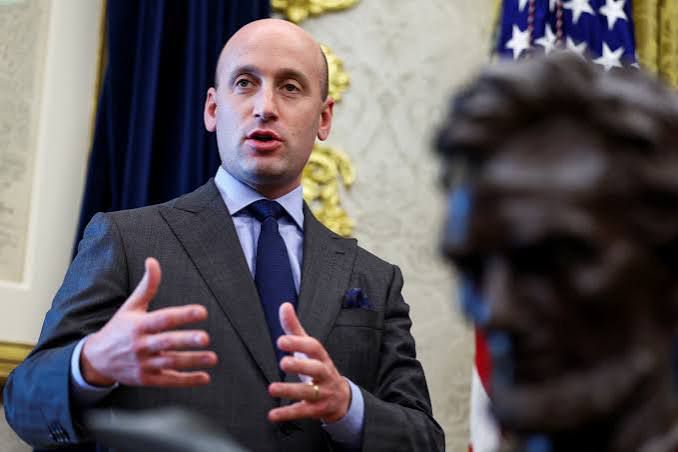
United States President Donald Trump has appointed his longtime trusted adviser and current Deputy Chief of Staff, Stephen Miller, as the new White House Chief of Staff, marking a significant restructuring of his administration following the Republican Party’s losses in the 2026 midterm elections.
Trump announced the appointment on Friday, confirming that Miller would officially assume the position on Monday, November 9, replacing Susie Wiles, who will transition to the president’s political operation after serving as the first woman to hold the influential White House position.
The appointment represents a major shift in the administration’s leadership structure at a particularly important moment in Trump’s presidency. With Democrats securing control of both chambers of Congress, the White House is preparing for a new political environment that will require strategic coordination, stronger executive leadership and careful management of relations with lawmakers.
Stephen Miller’s Growing Influence in the Trump Administration
Miller is one of the most influential figures in Trump’s political circle and has played a central role in developing and coordinating several major domestic policy initiatives, particularly immigration, border security and federal enforcement priorities.
Before his latest appointment, he served as Deputy Chief of Staff, overseeing domestic policy and helping translate the president’s political commitments into administrative action.
His involvement in shaping Trump’s immigration agenda has made him a prominent figure in American political discussions. He has also maintained a longstanding relationship with the president, having worked with him since his first presidential campaign.
His elevation to chief of staff therefore represents more than an ordinary personnel change. It places an experienced policy strategist and close presidential confidant at the centre of White House operations.
As chief of staff, Miller will be responsible for coordinating senior presidential advisers, managing the flow of information and decisions reaching the president, supervising White House operations and ensuring that the administration’s priorities receive attention across federal agencies.
A New Political Reality for the Trump Presidency
The appointment comes after a significant political development in Washington, with Democrats winning control of Congress in the November 2026 midterm elections.
The change in congressional leadership is expected to reshape the relationship between the executive and legislative branches when the new Congress begins its work in January 2027.
Democratic lawmakers are preparing to exercise their oversight responsibilities through congressional committees, investigations, hearings and legislative proposals concerning the administration’s policies and activities.
For Trump, the situation presents a different governing environment from the one he enjoyed when Republicans controlled Congress.
Consequently, the chief of staff position becomes particularly important. Miller will be expected to coordinate the administration’s response to congressional developments while helping the president maintain focus on his domestic and international priorities.
His responsibilities will likely include managing communication between the White House and congressional leadership, coordinating responses to legislative proposals and helping determine which presidential initiatives should receive immediate attention.
What Miller’s Appointment Could Mean for Immigration Policy
Immigration is expected to remain one of the most important areas of Miller’s influence.
He has been closely associated with Trump’s border-security agenda, immigration enforcement strategy and broader efforts to reshape American immigration policy.
His appointment suggests that these issues will continue to occupy a prominent position within the administration’s domestic policy framework.
However, the political environment surrounding immigration has become increasingly important following the midterm elections.
With Democrats preparing to exercise greater influence over congressional committees and legislative priorities, immigration policy could become a major subject of negotiations, oversight and national political debate.
Miller’s experience in this area may give the White House a more direct connection between presidential decision-making and the implementation of its immigration objectives.
The Strategic Importance of the Chief of Staff Position
The White House Chief of Staff is widely regarded as one of the most powerful unelected positions in the United States government.
Although the president retains ultimate executive authority, the chief of staff plays a critical role in determining how the administration functions daily.
The office coordinates presidential schedules, supervises senior advisers, manages internal communications and helps establish priorities for government decision-making.
The position also serves as an important link between the president, Cabinet officials, political advisers, lawmakers and other government institutions.
Miller’s appointment could therefore influence not only immigration policy but also the administration’s overall approach to economic issues, national security, federal governance and relations with Congress.
His close relationship with Trump is particularly significant because the effectiveness of a chief of staff often depends on the level of confidence and authority granted by the president.
Susie Wiles Moves to Trump’s Political Operation
Miller’s appointment also marks the end of Susie Wiles’ tenure as White House Chief of Staff.
Wiles made history as the first woman to occupy the position and played an important role in Trump’s political organisation, including his successful 2024 presidential campaign.
Trump praised her service and announced that she would move to his political operation, indicating that she would continue contributing to his broader political activities outside the traditional White House management structure.
Her experience in campaign organisation, political communication and strategic coordination could remain valuable as the administration prepares for the next phase of Trump’s presidency.
The transition also creates an opportunity for a reorganisation of responsibilities within the president’s inner circle, with Miller assuming direct control of White House staff coordination.
What Lies Ahead for the Trump Administration?
The coming months will provide an important test of the administration’s ability to operate under a Democratic-controlled Congress.
Miller’s immediate challenge will involve maintaining coordination within the White House while helping Trump navigate congressional oversight, legislative negotiations and the implementation of his policy commitments.
The administration will also need to balance its existing political priorities with the realities of a divided government.
For Democrats, control of Congress provides an opportunity to advance their legislative agenda and intensify scrutiny of executive decisions. For Republicans, the new political arrangement will require greater coordination between the White House and party members outside the executive branch.
Miller’s leadership will therefore be measured not only by his ability to manage White House operations but also by how effectively the administration responds to this changing political landscape.
A Defining Moment in Trump’s Second Administration
Ultimately, Trump’s decision to appoint Stephen Miller represents a consequential leadership development in his second presidential administration.
By promoting one of his closest advisers to the highest-ranking staff position in the White House, the president is placing considerable responsibility in the hands of someone who has helped shape his political and policy direction for years.
The transition comes at a time when the administration faces a changing congressional landscape, renewed political competition and important decisions concerning the future of American domestic and foreign policy.
Whether Miller’s appointment will strengthen the administration’s ability to advance its objectives under a Democratic-controlled Congress remains to be seen.
One thing is clear: his elevation places a central architect of Trump’s policy agenda at the heart of White House decision-making as the president enters a consequential new phase of his presidency.

