
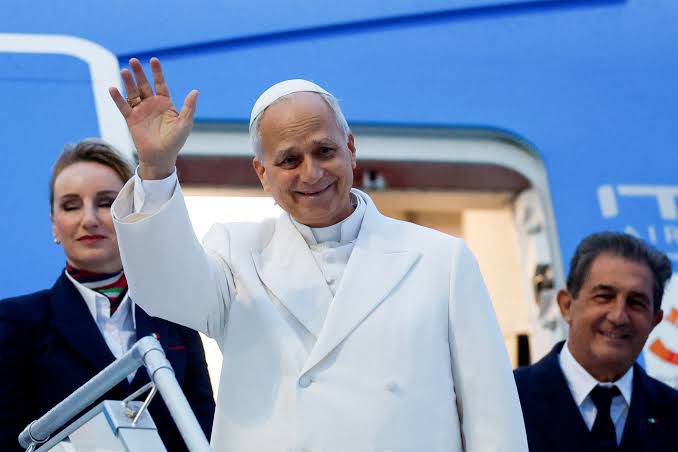
Pope Leo XIV has called on South American nations to strengthen regional cooperation and address shared challenges through dialogue, mutual respect and collective responsibility as he began a major 12-day apostolic journey across Uruguay, Argentina and Peru.
The pontiff arrived in Uruguay on Friday, November 6, marking the beginning of one of the most extensive overseas journeys of his papacy. His visit is expected to attract millions of people across the three countries, highlighting the Catholic Church’s continuing influence in a region experiencing significant political, economic and social transformations.
Speaking at the beginning of the tour, Pope Leo emphasised the importance of countries working together to address regional challenges rather than approaching common problems independently. His message placed particular emphasis on cooperation, respect for democratic institutions, peaceful negotiations and the need to build societies that provide opportunities for everyone.
The visit carries considerable religious and diplomatic significance, particularly as South America remains home to a substantial proportion of the world’s Catholic population.
Uruguay Welcomes the Pontiff
Uruguay became the first destination of the Pope’s three-country tour, marking the first papal visit to the country since Pope John Paul II travelled there in 1988.
His arrival in Montevideo attracted considerable attention from religious communities, government representatives and members of the public.
During his stay, Pope Leo is scheduled to meet President Yamandú Orsi, representatives of civil society, diplomatic officials and Catholic Church leaders.
His programme also includes religious celebrations, engagements with educational institutions and a visit to Casavalle, a community in Montevideo where issues surrounding poverty, social welfare and public safety remain important concerns.
The choice of Uruguay as the opening destination carries particular significance. Although the country has a strong historical Catholic heritage, it is among Latin America’s more secular societies.
The visit therefore provides an opportunity for the pontiff to engage with people beyond traditional church communities and communicate the Catholic Church’s perspectives on social responsibility, human dignity and community development.
Argentina Visit Carries Special Historical Significance
Following his engagements in Uruguay, Pope Leo will travel to Argentina on November 8, where he is expected to visit Buenos Aires, Córdoba and Luján.
Argentina holds particular importance in the history of the Catholic Church because it was the birthplace of Pope Francis, Leo’s predecessor and the first Latin American pontiff.
Pope Francis maintained a strong connection with the country throughout his religious life, although he never returned there during his papacy.
Leo’s visit consequently carries symbolic importance for Argentine Catholics, who will have an opportunity to welcome a successor to Francis and reflect on the legacy of the late pontiff.
During his stay, Leo is expected to meet President Javier Milei, government officials, religious leaders and representatives of different sectors of society.
Economic conditions, poverty, employment opportunities and social protection are expected to feature prominently in discussions surrounding the visit.
The Pope’s engagements will also include meetings with Christian communities, young people, university representatives and residents of charitable institutions.
His presence in Argentina provides an important opportunity for the Vatican to reinforce its relationship with a country whose religious identity remains closely connected to Catholic traditions.
Peru: A Personal and Spiritual Homecoming
Peru represents another particularly meaningful destination on the Pope’s itinerary.
Before becoming head of the Catholic Church, Leo XIV, born Robert Francis Prevost, spent many years undertaking missionary and pastoral responsibilities in the country. He also served as Bishop of Chiclayo and acquired Peruvian citizenship.
His return is therefore expected to generate considerable enthusiasm among communities that remember his earlier religious service.
The Peruvian leg of the journey will include visits to Lima, Chiclayo, Cusco and Pucallpa, providing opportunities for the pontiff to reconnect with former colleagues, religious communities and people he encountered during his years of service.
His programme includes meetings with government representatives, bishops, university communities, young people and local populations.
He is also expected to visit communities in the Amazon region, bringing attention to the importance of environmental protection, social inclusion and the welfare of populations living in geographically isolated areas.
The Peru visit is particularly significant because it combines the responsibilities of his current position as leader of the Catholic Church with personal connections developed over decades of missionary work.
Political Divisions and the Need for Regional Cooperation
Beyond its religious importance, the tour comes at a period of considerable political and economic change across South America.
Countries in the region are navigating different political ideologies, economic priorities, governance challenges and approaches to international relations.
Relations between neighbouring governments, economic inequalities, public security, employment and social welfare remain important subjects in regional discussions.
Against this background, Pope Leo’s appeal for collective action presents a broader message about the importance of regional institutions and constructive engagement.
His emphasis on dialogue and negotiation reflects the Catholic Church’s longstanding position that political and social disagreements should be addressed through peaceful engagement and respect for human dignity.
The Pope’s message also highlights the importance of cooperation in addressing challenges that extend beyond national borders, including environmental protection, migration, economic development and organised crime.
His appeal is particularly relevant to a region where geographical proximity, shared cultural traditions and economic relationships create opportunities for countries to pursue common objectives.
The Catholic Church’s Position in a Changing South America
South America has historically been one of the most important regions for the global Catholic Church, with millions of people maintaining strong religious and cultural connections to Catholicism.
However, religious affiliation across parts of the continent has been changing, with secularisation and the growth of other Christian denominations reshaping the religious landscape.
Pope Leo’s visit therefore represents an opportunity to strengthen relationships between the Church and local communities while addressing contemporary concerns affecting religious participation.
His engagements with young people, educational institutions, disadvantaged communities and political leaders demonstrate the Vatican’s interest in connecting religious teachings with practical social issues.
The visit also provides an opportunity to reinforce the Church’s role in promoting education, healthcare, humanitarian assistance, reconciliation and community development.
An Extensive Diplomatic and Religious Mission
The 12-day journey, scheduled to conclude on November 17, will cover approximately 31,000 kilometres across three countries and ten cities.
According to the Vatican’s published itinerary, the pontiff is expected to deliver approximately 36 speeches in Spanish and participate in numerous religious and diplomatic engagements.
His schedule includes Mass celebrations, meetings with government authorities, encounters with religious communities and visits to social institutions.
The scale of the journey reflects the importance the Vatican attaches to its relationship with Latin America.
It also provides an opportunity for Pope Leo to communicate his priorities directly to millions of Catholics and other members of the public.
A Message Extending Beyond Religion
Pope Leo’s South American tour is more than a series of religious appearances. It is also an opportunity to encourage cooperation, strengthen relationships and draw international attention to issues affecting communities across the continent.
By beginning in Uruguay, continuing to Argentina and concluding in Peru, the pontiff is connecting three countries with different political circumstances but significant historical, cultural and religious ties.
His call for regional unity places collective responsibility at the centre of his message, encouraging governments and communities to recognise shared interests while respecting their individual national identities.
As the journey continues, attention will remain on the Pope’s engagements with political leaders, religious institutions, young people and disadvantaged communities.
Ultimately, the success and significance of the visit will be reflected not only in the crowds it attracts but also in the conversations it generates about cooperation, human dignity, economic opportunity and the future of South America.

