
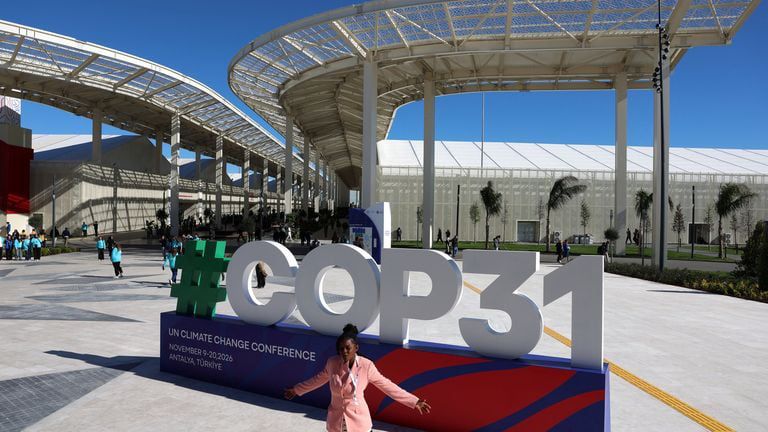
ANTALYA, TURKEY | NOVEMBER 8, 2026
Global climate negotiations opening in Turkey on Monday are unlikely to produce major new commitments to reduce greenhouse gas emissions, according to Singapore’s Environment Minister Grace Fu, who believes governments should concentrate on implementing climate measures and agreements already established under international frameworks.
Speaking to reporters ahead of the annual United Nations climate conference, Fu suggested that expectations for significantly stronger emissions reduction targets should remain modest, arguing that countries already have substantial commitments under the Paris Agreement that require urgent attention and implementation.
“I think that we are not expecting a major upgrade in mitigation targets” at the annual UN talks in Turkey, Fu said.
“But we have enough, even within the Paris Agreement, with what we have already agreed on. There is enough to work on.”
Her comments highlight an important challenge facing international climate diplomacy: translating existing promises into measurable environmental progress.
IMPLEMENTATION TAKES CENTRE STAGE
The upcoming negotiations are expected to focus heavily on how governments can accelerate the implementation of existing climate commitments.
Although countries have made various promises to reduce emissions, transition towards cleaner energy and strengthen environmental protection, progress has remained uneven.
For Fu, the immediate priority should be ensuring that governments deliver on commitments already made rather than concentrating exclusively on announcing more ambitious targets.
The Paris Agreement, adopted in 2015, established an international framework for limiting global warming and encouraging countries to strengthen their climate policies.
However, achieving its objectives requires sustained cooperation, investment, technological development and effective national policies.
DEVELOPING COUNTRIES SEEK CLIMATE SUPPORT
Another important issue expected to feature prominently in the negotiations is financial assistance for developing countries.
Many developing economies face the difficult task of expanding infrastructure, improving electricity access and creating employment while reducing their environmental impact.
Climate financing, technology transfer and adaptation programmes therefore remain important components of international discussions.
Countries vulnerable to rising sea levels, extreme weather events and changing rainfall patterns are particularly interested in securing practical assistance to strengthen their resilience.
WHY THE PARIS AGREEMENT STILL MATTERS
The Paris Agreement remains the foundation of global climate cooperation, bringing countries together under a common framework to address climate change.
Its central ambition is to keep the increase in global average temperatures well below 2°C above pre-industrial levels while pursuing efforts to limit the increase to 1.5°C.
However, achieving these objectives requires countries to strengthen their domestic policies, reduce dependence on high-emission energy sources and invest in sustainable technologies.
The challenge is no longer simply securing international promises but ensuring that those promises translate into meaningful results.
A TEST OF INTERNATIONAL CLIMATE COOPERATION
Fu’s remarks introduce a practical perspective into the upcoming negotiations, suggesting that the effectiveness of international climate diplomacy should be measured by implementation rather than the number of new commitments announced.
Nevertheless, environmental advocates and climate-vulnerable countries continue to argue that stronger emissions reduction ambitions are necessary to address the growing risks associated with global warming.
This creates an important balancing act for negotiators: maintaining pressure for greater climate ambition while ensuring that existing agreements receive the attention, financing and political commitment required for successful implementation.
As representatives from governments and international organisations gather in Turkey, the negotiations will provide another opportunity to assess the world’s progress in addressing climate change.
For Singapore, the priority is clear: countries already have significant commitments under the Paris Agreement, and delivering on them must remain central to the global response.
The real question facing world leaders is whether existing climate promises can finally be transformed into concrete action before the environmental and economic consequences of global warming become even more difficult to manage.

