
Washington, United States | November 8, 2026:
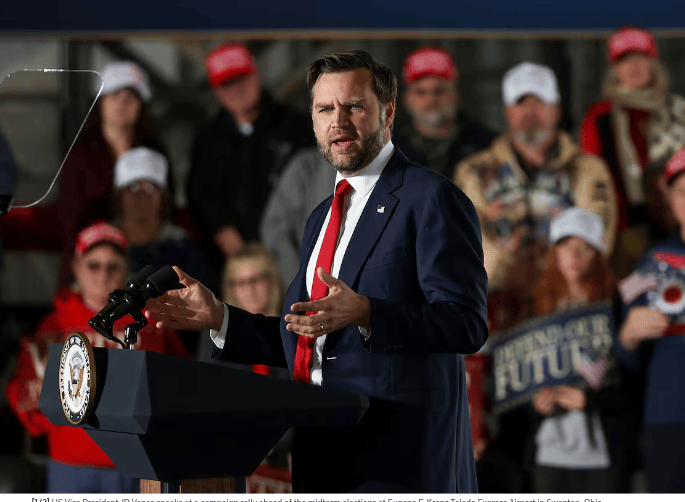
United States Vice President JD Vance is increasingly placing his personal political identity at the centre of his public engagements, signalling a new phase in his political journey following the November 3 midterm elections.
In the closing stages of the Republican Party’s midterm campaign, Vance gradually adjusted his communication strategy, placing greater emphasis on policy issues associated with his own political philosophy while making fewer references to President Donald Trump.
According to a Reuters report, an examination of six speeches delivered by Vance since the Republican convention in September revealed a consistent emphasis on his policy priorities rather than a broader defence of the president’s political agenda.
The development highlights Vance’s growing interest in defining the Republican Party’s future through issues that reflect his political identity, particularly economic nationalism, foreign policy restraint and public safety.
A Policy-Driven Political Identity
Vance’s recent political messaging has increasingly centred on economic opportunities, national security, domestic stability and the protection of American interests.
His emphasis on economic nationalism reflects an approach that prioritises American industries, domestic production, employment opportunities and economic independence.
Through this position, Vance has continued to present himself as a political figure interested in connecting national economic policies with the everyday experiences of American households.
Public safety has also featured prominently in his speeches, alongside discussions about healthcare programmes, government accountability and the management of public resources.
These subjects provide an important foundation for understanding the political identity Vance is developing within the Republican establishment.
Foreign Policy and the Iran Question
Foreign policy has emerged as another defining component of Vance’s political outlook.
Following the midterm elections, the vice president publicly identified the war involving Iran as an important factor in the Republican Party’s electoral outcome.
He subsequently advocated a swift conclusion to the conflict, bringing renewed attention to his longstanding preference for a more restrained approach to American military involvement overseas.
His position has also generated wider discussions about America’s international relationships, military commitments and the economic implications of prolonged overseas engagements.
The foreign policy debate is particularly significant because it presents an opportunity for Vance to articulate how his understanding of American national interests could shape future Republican leadership.
The Republican Party’s Next Political Chapter
The Democratic Party’s victory in the midterm elections has created a new political environment in Washington, with Democrats securing control of both chambers of Congress.
For Republicans, the immediate priority is developing a coordinated political direction while preparing for the next phase of national governance.
Vance’s growing emphasis on his individual policy priorities places him among the prominent figures participating in conversations about the party’s future.
Other Republican leaders, including Senator Ted Cruz, Florida Governor Ron DeSantis and Secretary of State Marco Rubio, have also become relevant voices in discussions about the party’s political direction.
Their different perspectives demonstrate the range of policy considerations currently shaping Republican conversations.
The 2028 Political Dimension
Vance’s emerging political identity has naturally attracted attention because of the approaching 2028 presidential election cycle.
Although he has not formally announced a presidential campaign, his increasing emphasis on personal policy positions provides an opportunity to establish a recognisable political profile.
His challenge will involve defining his own approach while maintaining relationships with the Republican coalition that brought him into national leadership.
The relationship between his political philosophy, the Trump administration’s broader agenda and the expectations of Republican voters will remain central to discussions about his future.
Political Analysis: A New Phase of Leadership
Vance’s evolving communication strategy represents an important development in the changing dynamics of American Republican politics.
The vice presidency provides a national platform through which he can communicate policy ideas, engage different constituencies and participate in conversations about America’s domestic and international priorities.
By highlighting economic nationalism, public safety and foreign policy restraint, Vance is presenting a political identity with clearly identifiable policy themes.
The November midterm elections have also created an opportunity for Republican leaders to examine voter priorities and consider how their policies can respond to changing economic and international circumstances.
For Vance, this period offers an opportunity to demonstrate how his political philosophy fits into the Republican Party’s next chapter.
His future influence will depend on how effectively he connects his policy priorities with the expectations of voters, party members and other political stakeholders.
As Washington enters a new congressional era, JD Vance’s political evolution will remain an important development to watch, particularly as conversations about Republican leadership and the 2028 presidential race gradually take shape.

