
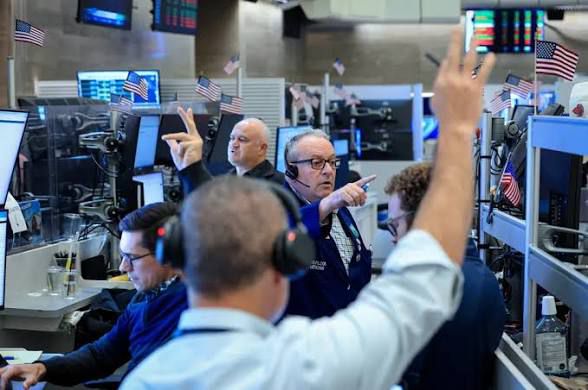
The American technology industry has suffered a major stock market setback following the Democratic Party’s sweeping victory in the 2026 midterm elections, with investors rapidly selling technology shares amid fears of tougher government regulations targeting artificial intelligence (AI) companies and data centre expansion.
On Thursday, November 5, the Nasdaq Composite plunged 5.5%, entering official correction territory after falling approximately 12% from its record high in October. The sell-off wiped out trillions of dollars in market value, with estimates putting the losses at approximately $2.5 trillion to nearly $3 trillion across major technology-heavy stocks and the broader S&P 500 market capitalisation.
The market reaction followed Democrats’ victory in both chambers of Congress, raising concerns that the incoming congressional leadership could introduce stricter oversight of technology companies, particularly those investing billions of dollars in artificial intelligence infrastructure.
Why Investors Are Selling Technology Stocks
At the centre of the market turbulence is growing uncertainty surrounding America’s rapidly expanding AI industry.
Major technology companies have committed enormous financial resources to building data centres, purchasing advanced computer chips and developing artificial intelligence systems.
However, these facilities require enormous amounts of electricity and water, raising concerns about pressure on local energy supplies, environmental sustainability and infrastructure costs.
Investors fear that Democratic lawmakers could introduce stricter environmental requirements, electricity regulations and additional approval procedures for new data centre projects.
Such measures could increase operating expenses, delay construction and affect the profitability of companies investing heavily in AI infrastructure.
Chipmakers And Technology Giants Feel The Pressure
The sell-off particularly affected semiconductor manufacturers and companies connected to AI infrastructure.
Nvidia shares declined approximately 9%, while AMD plunged around 17%. The Philadelphia Semiconductor Index also dropped approximately 12%, reflecting the widespread pressure on the chip industry.
Smaller AI infrastructure companies also experienced significant losses as investors questioned whether their ambitious expansion plans could generate sufficient returns.
The developments have raised concerns about the financial sustainability of the enormous investments currently driving the artificial intelligence revolution.
What Democrats’ Victory Means For Big Tech
The Democratic-controlled Congress could increase scrutiny of major technology companies through investigations, legislation and oversight of energy consumption, environmental standards and data centre development.
However, stricter regulation does not necessarily mean opposition to artificial intelligence.
Democrats could instead push for responsible AI development that balances technological innovation with environmental protection, consumer interests and reliable electricity supplies.
The challenge will be ensuring that regulatory requirements do not unnecessarily discourage investment or weaken America’s competitiveness in the global AI industry.
Is This The Beginning Of An AI Market Crisis?
Despite Thursday’s dramatic losses, financial analysts have cautioned against interpreting the sell-off as the end of the artificial intelligence investment boom.
The market decline reflects a combination of regulatory uncertainty, concerns about enormous AI spending commitments, expensive technology valuations and questions about future profitability.
Reuters reported on November 6 that Nasdaq futures recovered as semiconductor shares stabilised following Thursday’s market rout.
This suggests that investors are reassessing the risks surrounding AI infrastructure rather than necessarily abandoning the technology’s long-term commercial potential.
The $3 trillion technology market rout highlights the growing relationship between American politics, government regulation and global financial markets.
Democrats’ congressional victory has introduced uncertainty into an industry that has become one of the biggest drivers of stock market growth.
For technology companies, the immediate challenge is balancing ambitious AI expansion plans with the possibility of stricter regulatory requirements.
For investors, the coming months will be crucial in determining whether the market experiences a temporary correction or a more prolonged reassessment of artificial intelligence valuations.
Ultimately, America’s ability to maintain its leadership in artificial intelligence may depend on finding a balance between technological innovation, responsible regulation, energy security and sustainable investment.

